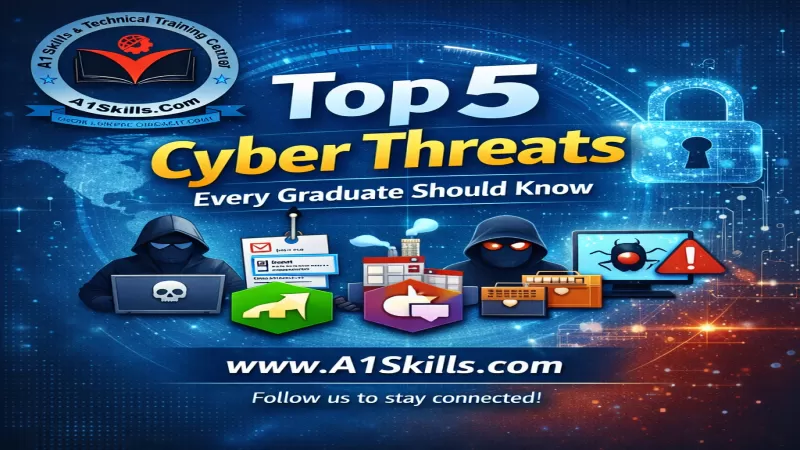
Top 5 Cyber Threats Every Graduate Must Understand in 2026
Why Cyber Awareness Is Your Career Superpower
Whether you’re stepping into HR, customer service, administration, or any non‑tech role, cyber threats are part of your daily reality. Employers today expect every professional — not just IT staff — to have basic cyber awareness.
According to LinkedIn’s 2026 Skills Report, cyber security awareness is among the top 10 skills recruiters look for in fresh graduates. And Indeed’s Career Guide shows that 60% of entry‑level employees face phishing attempts within their first year of work.
So, if you’re preparing for your first job, here are the five cyber threats you must know — explained simply, with practical tips to protect yourself and your organization.
1. Ransomware Attacks
Hackers lock company data and demand payment to release it. Modern ransomware often involves double extortion — stealing data before encrypting it.
-
Why it matters: Even non‑executive staff can trigger ransomware by opening unsafe attachments.
-
Quick tip: Never download files from unknown sources. Always report suspicious emails.
2. AI‑Driven Phishing
Phishing emails are now powered by AI, making them personalized and convincing. They may look like messages from your boss or HR.
-
Why it matters: Finance and HR teams are prime targets.
-
Quick tip: Double‑check sender addresses and use two‑factor authentication.
3. Supply Chain Breaches
Attackers infiltrate organizations through vendors or third‑party providers.
-
Why it matters: Even small companies can be exploited to attack larger enterprises.
-
Quick tip: Limit vendor access and monitor unusual system activity.
4. Advanced Persistent Threats (APT)
APT groups are stealthy, often state‑backed, and conduct long‑term spying.
-
Why it matters: Entry‑level employees may unknowingly expose credentials.
-
Quick tip: Use strong, unique passwords and report anomalies immediately.
5. Exploit‑Based Malware
Malware exploits outdated software or weak patches. Trojans and viruses remain the most common corporate threat.
-
Why it matters: Fresh graduates often use outdated apps or click unsafe links.
-
Quick tip: Keep software updated and avoid pirated applications.
🌱 Why Graduates Should Care
-
Cyber threats affect every role, not just IT.
-
Employers value digital safety awareness as part of soft skills.
-
Knowing these risks boosts your confidence in interviews and workplace readiness.
🧩 How to Test and Improve Your Cyber Skills
-
Take our free self‑assessment at A1Skills.com to discover your strengths and weaknesses in cyber awareness.
-
Enroll in the Cyber Security Introductory Course to learn practical skills like spotting phishing emails, protecting passwords, and safe browsing habits.
-
Read career mentoring blogs on A1Skills.com to stay updated on evolving workplace risks.
💬 Final Thoughts
Cyber threats are evolving faster than ever. By understanding ransomware, phishing, supply chain breaches, APTs, and malware, you’ll not only protect yourself but also prove to employers that you’re adaptable, responsible, and ready for professional growth.
👉 Think you already know everything? Challenge yourself with our free self‑assessment program and earn a certificate that highlights your cyber awareness. Or take the next step by enrolling in our Cyber Security Introductory Course — your gateway to becoming a digitally smart professional.
All The Best!
Reviews (1)
N.
N.P. Singh
Understanding of cyber security is must to know daily online scams and cheat happening.
Leave a Review
Your email address will not be published. Required fields are marked *
Recent Post