Understanding the Real Difference Between Tech Jobs vs Non‑Tech Jobs:
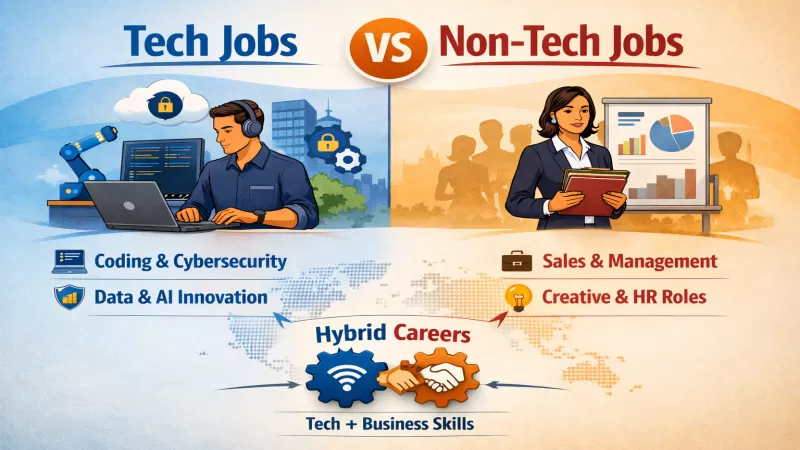
Tech Jobs vs Non‑Tech Jobs: Understanding the Real Difference
In today’s interconnected world, every profession — whether technical or non‑technical — plays a vital role in shaping industries and innovation. Yet, many professionals still wonder: What truly separates tech jobs from non‑tech jobs?
This article explores that distinction from a global, future‑ready perspective, helping readers identify where their skills fit best and how to grow in either direction.
📊 The Global Employment Spectrum
Across the world, technology continues to reshape how we work. Studies show that digital transformation has created millions of new tech‑driven roles, while non‑technical positions remain the backbone of business operations.
|
Job Category |
Share of Global Opportunities |
Key Drivers |
|
Tech Roles |
Expanding rapidly |
Automation, AI, data analytics, cloud computing |
|
Non‑Tech Roles |
Steady and essential |
Creativity, management, customer engagement |
|
Category |
Share of Global Opportunities |
Growth Drivers |
|
Tech Jobs |
~40% |
Automation, AI, data analytics, digital transformation |
|
Non‑Tech Jobs |
~60% |
Human interaction, creativity, management, service delivery |
The takeaway? Both sectors are thriving — but success depends on how well you adapt and combine skills from each.
💻 What Defines a Tech Job?
Tech jobs revolve around building, maintaining, or innovating technology systems. They demand analytical thinking, precision, and continuous learning.
🔧 Common Examples
-
Software Developer
-
Data Scientist
-
Cybersecurity Analyst
-
Cloud Engineer
-
AI Specialist
🧩 Core Traits
-
Involves coding, algorithms, or digital tools.
-
Focused on innovation and automation.
-
Requires logical reasoning and technical expertise.
💡 Example: A cybersecurity analyst protects an organization’s data from threats using encryption and monitoring tools — a purely technical responsibility.
💼 What Defines a Non‑Tech Job?
Non‑tech jobs emphasize human connection, creativity, and strategic decision‑making. They may use technology but don’t rely on deep technical skills.
🗂️ Common Examples
-
Marketing Manager
-
HR Executive
-
Sales Consultant
-
Financial Advisor
-
Educator
🧩 Core Traits
-
Focused on communication and leadership.
-
Involves managing people, ideas, and outcomes.
-
Requires emotional intelligence and adaptability.
💡 Example: A marketing manager uses analytics tools but focuses on storytelling, branding, and customer engagement — blending creativity with insight.
🔍 Comparing Tech and Non‑Tech Roles
|
Aspect |
Tech Jobs |
Non‑Tech Jobs |
|
Primary Focus |
Technology creation and maintenance |
People, processes, and creativity |
|
Skills Needed |
Coding, data analysis, system design |
Communication, leadership, management |
|
Work Environment |
Analytical, digital, project‑based |
Collaborative, strategic, customer‑focused |
|
Growth Path |
Driven by innovation |
Driven by experience and leadership |
|
Examples |
Software Engineer, Data Analyst |
HR Manager, Marketing Strategist |
🌐 The Convergence: Hybrid Roles
Modern careers increasingly blend both worlds.
-
A digital marketer uses analytics and creative storytelling.
-
A product manager understands both business strategy and technical feasibility.
-
A UX designer combines psychology, design, and coding.
These hybrid roles are in high demand globally because they connect technology with human experience.
🧠 Skills That Matter in Both Worlds
Regardless of your field, success depends on mastering a mix of technical and interpersonal skills.
🔑 Universal Skills
-
Communication and collaboration
-
Critical thinking and problem‑solving
-
Digital literacy and cyber awareness
-
Adaptability and emotional intelligence
-
Leadership and project management
💡 Explore career‑focused skill courses at A1Skills.com to strengthen these abilities and stay globally competitive.
📚 Real‑World Illustrations
-
Tech Example: A software engineer develops an app that simplifies online learning.
-
Non‑Tech Example: A teacher uses that app to engage students creatively.
-
Hybrid Example: A project manager coordinates both teams to ensure success.
Each role contributes uniquely — proving that technology and human insight are inseparable.
🌍 Global Perspective
|
Region |
Tech Focus |
Non‑Tech Focus |
|
North America |
AI, cloud computing, data science |
Marketing, management, finance |
|
Europe |
Green technology, cybersecurity |
Education, HR, sustainability |
|
Asia |
Software development, automation |
Operations, customer service, business strategy |
|
Middle East & Africa |
Smart infrastructure, fintech |
Tourism, logistics, entrepreneurship |
🧩 How to Choose Your Path
Ask yourself:
-
Do I enjoy solving technical problems or managing people?
-
Am I more analytical or creative?
-
Do I prefer working with systems or with stories?
Your answers reveal whether you belong in tech, non‑tech, or a hybrid role.
🧠 Self‑Assessment and Growth
If you think you already know your career direction, take the free self‑assessment at A1Skills.com to evaluate your strengths and weaknesses. It helps you discover whether your skills align more with technology, management, or creative innovation.
🎓 Recommended Courses at A1Skills.com
-
Cyber Security Awareness — for tech enthusiasts.
-
Soft Skills & Communication Mastery — for non‑tech professionals.
-
Digital Marketing & Analytics — for hybrid learners.
-
Leadership & Emotional Intelligence — for all career levels.
Each course is designed to help you grow professionally and personally — without boundaries.
📖 Read and Reflect
Explore career mentoring blogs on A1Skills.com to learn how professionals worldwide balance technical expertise with human connection. These blogs inspire readers to think beyond job titles and focus on career purpose and adaptability.
🚀 Final Thoughts
The difference between tech and non‑tech jobs isn’t about competition — it’s about collaboration. Technology drives progress, but human creativity gives it meaning.
Whether you’re coding software or crafting strategies, your success depends on how well you combine knowledge, empathy, and adaptability.
👉 If you think you already know enough, challenge yourself with A1Skills.com’s free self‑assessment program to test your awareness. 👉 If you want structured learning, explore career‑focused skill courses to refine your strengths and bridge your gaps.
Together, we can build a world where technology and humanity grow side by side.
Happy Learning!
Reviews (3)
WA
Wai zai
Informative.
KR
Krishan Kumar
thanks for this information, helpful understanding before apply.
PR
Prakesh
Nice article to learn the difference between tech and non-tech jobs.
Thank you, sir.
Leave a Review
Your email address will not be published. Required fields are marked *
Recent Post